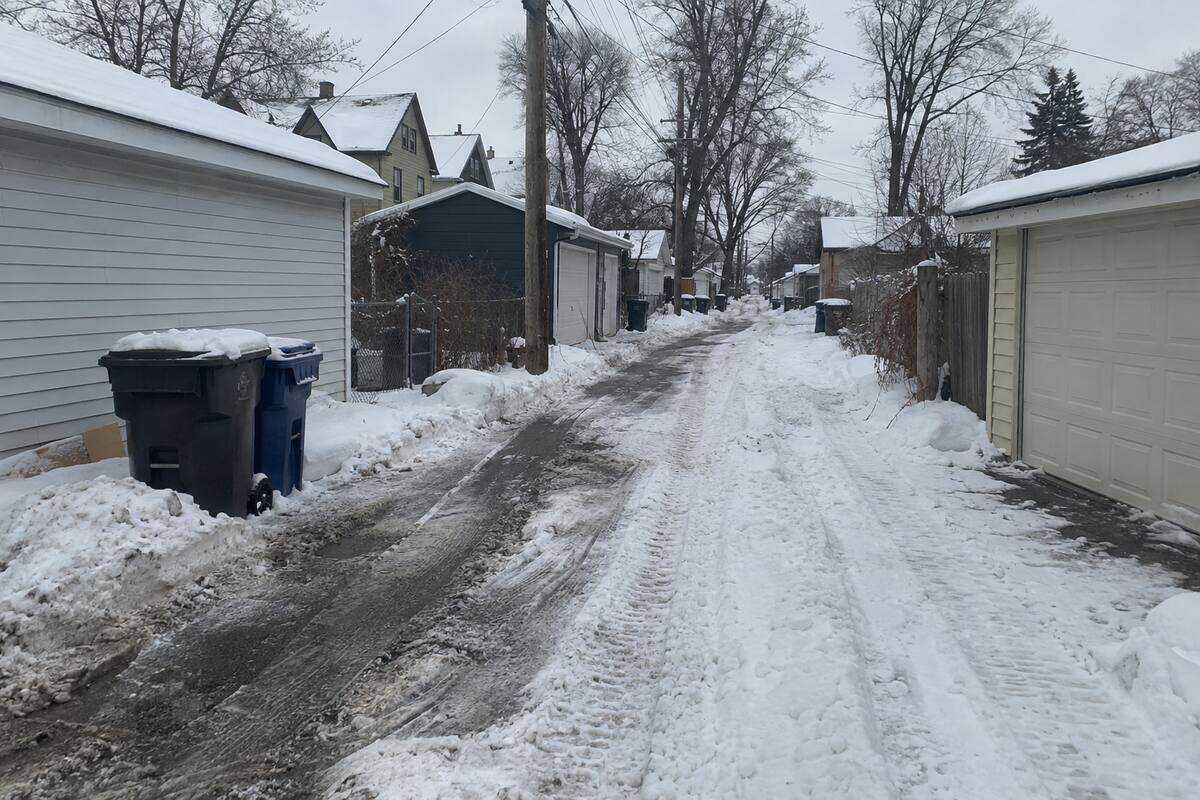
The City of Saint Paul has never plowed alleys. Not as a budget cut and not this winter — never, in the city’s own words. If your garage opens onto an alley, clearing it is arranged and paid for by the households on the block. Here is how that works, what it costs, and a calculator for splitting it.
Twin Cities Snow Plowing is a referral service. It does not plow alleys and does not offer to. Alley work is carried out by independent operators under their own company names and their own insurance.
Ten minutes separates two completely different municipal positions on the same piece of pavement.
Minneapolis Public Works clears roughly 400 miles of alleys as an ordinary municipal service, and re-plows them to break down ice. Alley clearing is part of what a Minneapolis property owner is already paying for.
The city’s published position: it “has never plowed, salted, or sanded alleys in winter.” Saint Paul has hundreds of miles of alleys and no municipal program for any of them. The responsibility sits with the households whose property lines touch the alley.
This catches people constantly, and understandably — a homeowner moving from Longfellow to Macalester-Groveland has no reason to expect the answer to change. It also catches people who have lived in Saint Paul for years but on a street without an alley.
Saint Paul has a name for the arrangement, and it appears on the city’s own pages: the alley captain. One resident on the block volunteers to coordinate — collecting money from the households along the alley, choosing the operator and holding the arrangement together through the winter.
It is not a fringe practice. A 2019 University of Minnesota study commissioned by the city itself found that 66% of surveyed residents with alleys used the alley-captain model. It is concentrated in the 55104, 55105 and 55116 ZIP codes — Wards 3 and 4, the western half of the city. Reporting on it has named West Seventh, Highland, Macalester-Groveland, Frogtown and Edmund Avenue as blocks running the arrangement.
The city acknowledges the practice and then stops. It keeps no list of contractors, makes no recommendations, and states plainly that it “cannot make recommendations or estimates about a ‘good cost’”. It also notes that plow companies do not have to be licensed to operate in Saint Paul, which is accurate and worth sitting with: there is no registry, no license number to check, and no municipal complaint route if the work is not done. The certificate of insurance is the only verification that exists.
That same University of Minnesota study flagged something else worth naming. Blocks with more renters and lower owner-occupancy struggle to organize and to front the money, because the arrangement depends on one person being willing to chase twelve neighbors for $30 each before the first snow. The alleys that go uncleared are not the ones that decided against it. They are the ones where nobody volunteered.
The spread is driven by alley length, how many turns and dead ends it has, whether there is anywhere to stack the snow, and how many households are splitting it. A short alley with eight houses and a corner to push snow into prices very differently from a long one with twenty and nowhere to put anything.
The hardest part of being an alley captain is telling neighbors a number. Put the bid in, put the household count in, and it gives you the per-household figure — plus the figure if two or three houses decline, which is the situation that actually comes up.
Nothing entered here is sent anywhere or stored. It is arithmetic in your browser.
Give the cross streets, roughly how long the alley is and how many households back onto it. That is enough for an operator to price the block.
Call (612) 712-4640 Get a Seasonal Quote Twin Cities