The driveway is the part everybody prices and the part nobody asks questions about. Three contract terms decide whether you are happy in February, and none of them is the headline number.
Two inches is the residential standard across every Twin Cities operator checked. That number is not arbitrary and it is not negotiable downward for free, because it maps directly onto how often anyone drives to your house.
Minnesota DNR counts at the Twin Cities station since 1891 give the average season 37.2 days with 0.1″ or more, 14.3 days with 1″ or more, and 7.6 days with 2″ or more. Move the trigger from two inches to three and you have roughly halved the number of qualifying events. Move it to one inch and you have roughly doubled it — and the price with it.
So when two quotes differ by $150, check the trigger before you assume one operator is cheaper. Frequently they are quoting different services at different depths.
Here is the sequence that produces the single most common winter complaint. Your driveway gets cleared at 5 a.m. The city plow comes through at 9 a.m. and deposits a dense, compacted berm across the bottom of your apron. You now have a cleared driveway you cannot get out of.
The city is not coming back for it. Saint Paul has said so on the record: with 1,874 lane miles to maintain, plows must stay focused on opening the streets, and snow accumulating at property lines is treated as an unavoidable consequence. Minneapolis addresses only the corner case — owners need not clear plow piles beyond the gutter at corners — and says nothing about relieving anyone of the driveway apron.
So the question for October is simple: does the contract include a return pass for the plow ridge, or is that billed separately? Both answers are legitimate. Only one of them is a surprise in January.
Free mitigation, published by Minneapolis, Saint Paul and Plymouth alike: pile your own shoveled snow on the left side of the driveway as you face the street, so the city plow’s next pass carries it past the apron rather than into it.
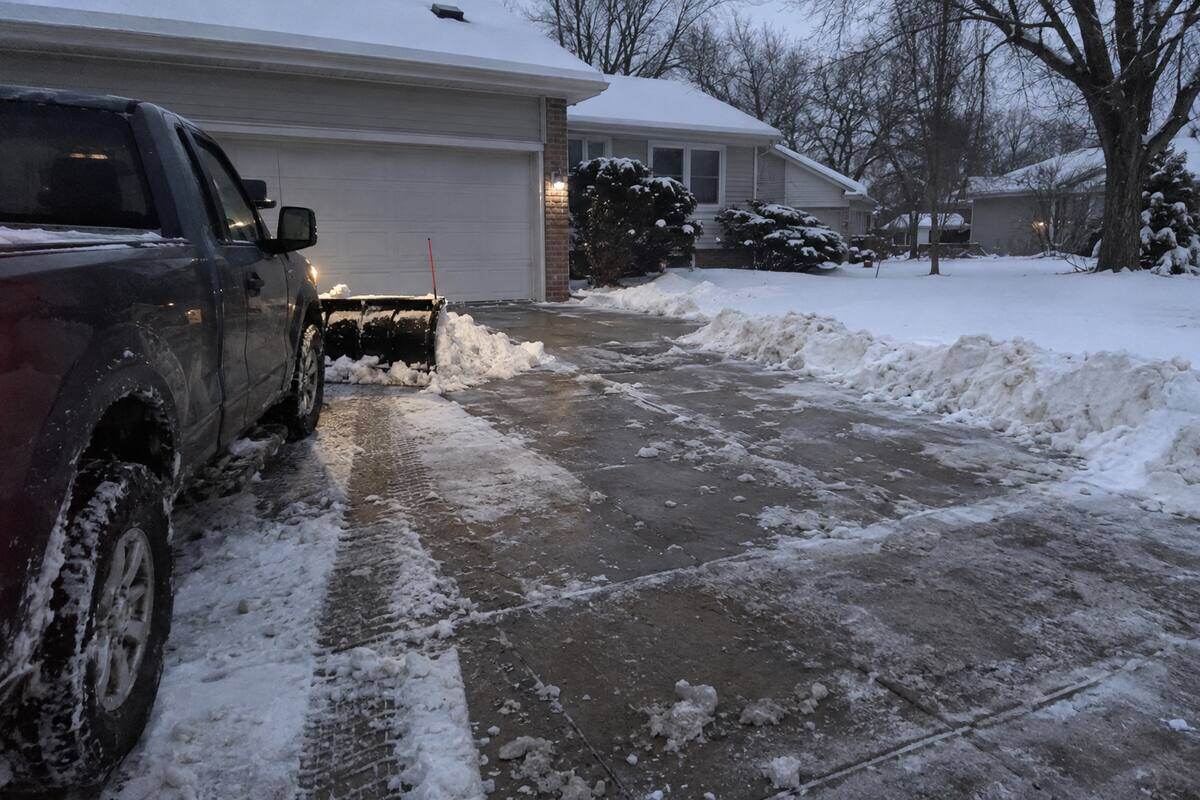
An average 51-inch winter fits on most Twin Cities lots. February 2019 — 39 inches in a single month, beating the previous record by over a foot — did not. Banks get high enough to block sightlines at the end of the driveway, and on a narrow city lot with a detached garage there is genuinely nowhere left.
It cannot go in the street: that is a misdemeanor under Minn. Stat. § 169.42, and the statute reaches you as well as the operator. The statute and the penalties. What remains is the yard, the boulevard, or hauling it off site. Ask which of those an operator is planning on, and ask before the banks are five feet tall.
Both cities also ask that fire hydrants and gas meters stay clear, which is worth folding into the same conversation.
Driveway edges, sprinkler heads and the ends of a gravel apron get marked with stakes before the ground hardens. Skip it and the first heavy event takes an edge, a head or a stretch of sod with it — damage that shows up in April and is nobody’s fault by then.
This is one of the practical reasons booking in October beats booking in December, alongside the more obvious one: routes fill before the snow, not after it. The average date of the first one-inch snowfall here is November 18, and the record is September 26.
Driveway size, sidewalk frontage, corner or not, and whether there are steps or a walk to the door.
Call (612) 712-4640 Get a Seasonal Quote Twin Cities